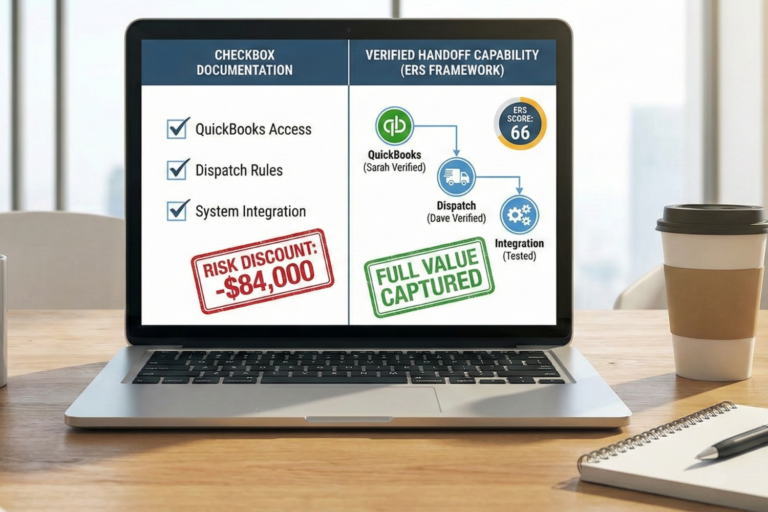
Most business owners believe their vendor relationships will transfer smoothly when they sell. The truth is more complicated. A vendor due diligence checklist helps you identify which supplier agreements will survive the sale and which will disappear the moment you step away.
Missing vendor contracts create friction during buyer review. Informal pricing deals negotiated over the years can vanish when account ownership changes. Backup contacts you never documented become critical gaps when due diligence starts. These problems show up fast, and they cost you time, credibility, and potentially the deal itself.
This checklist walks you through the exact vendor documentation buyers examine before closing. You will learn how to audit existing contracts, fix missing agreements, and build a transfer readiness score that signals preparation instead of risk.
What Is a Vendor Due Diligence Checklist?
A vendor due diligence checklist is a structured review of all supplier relationships and contracts tied to your business operations. It documents pricing agreements, payment terms, entity ownership, and backup contacts for every vendor that keeps your business running.
Business owners typically need this checklist when preparing for a sale, starting the due diligence process, or responding to buyer requests for supplier documentation. The timing matters because missing vendor contracts discovered late in a transaction can delay closing or trigger price renegotiations.
Vendor due diligence differs from general due diligence in scope and focus. A general due diligence checklist covers financial records, legal compliance, customer agreements, employee contracts, and operational systems across the entire business. Vendor due diligence zeros in on third-party vendors and examines whether supplier relationships will transfer cleanly to new ownership. This narrower focus helps buyers assess operational risk and continuity planning gaps that affect business operations after the sale closes.

Why Do Buyers Review Vendor Contracts During Due Diligence?
Buyers review vendor contracts to judge whether the business can operate normally after ownership changes. Clear, signed agreements show operational continuity, stable pricing, and predictable payment terms. Missing or informal contracts raise concerns about service disruption, margin changes, or suppliers renegotiating once the owner exits. Because vendor relationships often support logistics, technology, and compliance functions, buyers treat weak documentation as direct operational risk and may adjust valuation or deal terms.
They also check account ownership and relationship depth. Vendor accounts registered to the business entity usually transfer smoothly, while personal accounts require approvals or migrations that delay closing. Documented backup contacts further reduce continuity risk by preventing single-point-of-failure relationships. Clean entity ownership, written pricing, and secondary contacts signal professional management and lower post-sale friction.
Vendor Documentation Checklist for Business Owners
Complete vendor documentation includes five elements that buyers check during due diligence. Missing any item can delay the deal and signal operational risk.
- Written contracts and renewal dates – Signed agreements with pricing, terms, service levels, and renewal clauses. Verbal or email-only agreements are weak evidence.
- Documented pricing and discounts – Written pricing schedules, tiers, and rebates that prove cost advantages belong to the business, not personal relationships.
- Payment terms and credit arrangements – Net-30/60 terms and credit limits in writing to support cash-flow planning and clarify entity vs. personal guarantees.
- Legal entity name on vendor accounts – Accounts registered to the business entity transfer smoothly and reduce post-closing friction.
- Backup contact for critical suppliers – At least one alternate contact with current details to prevent single-point-of-failure risk and protect continuity.

How to Run a Vendor Contract Audit Step-by-Step
A vendor contract audit moves from inventory to transfer-readiness scoring and usually takes 2–4 weeks, depending on vendor count and documentation quality.
Step 1: List All Active Vendors
Pull the last 12 months of vendor payments from your accounting system. Export and sort by annual spend to see which suppliers have the biggest financial impact. Include software, services, logistics, equipment, and compliance vendors.
Step 2: Prioritize High-Risk Vendors
Focus on vendors that are expensive, critical to daily operations, single-source, or that handle sensitive data or compliance. Lower-cost, easily replaceable vendors need only a light review.
Step 3: Gather Contracts and Pricing Proof
Collect signed agreements, pricing schedules, proposals, and confirmation emails from drives, inboxes, and file storage. Note missing or incomplete documentation.
Step 4: Verify Account Ownership
Check invoices or vendor portals to confirm accounts are registered to the business entity, not personal names, emails, or credit cards. Flag any personal ownership risks.
Step 5: Score Transfer Readiness
Assign each key vendor a 1–5 score based on contract completeness, entity ownership, documented pricing, and backup contacts. This highlights which relationships will transfer smoothly and which may delay due diligence.

What Is a Vendor Transfer Readiness Score?
A vendor transfer readiness score rates how easily a supplier relationship can move to new ownership. Scores range from 1 to 5, with higher numbers indicating cleaner transfer and lower buyer risk.
Score Bands
- 5 – Strong: Written contract, entity-level account ownership, clear pricing and terms, and a backup contact.
- 3 – Moderate: Partial documentation, mixed personal/entity ownership, and informal or missing backups.
- 1 – Weak: No contract, personal ownership, verbal pricing only, and no backup contact.
Why It Matters
Low scores signal post-closing risk such as pricing changes, service disruption, or vendor approval delays. Buyers may respond with valuation discounts, earnouts, or requests for seller involvement, especially for strategic vendors.
Improvement Potential
Mid-range scores are usually fixable before sale. Formalizing pricing, switching accounts to the business entity, and adding backup contacts can quickly raise readiness and prevent diligence slowdowns.
High Scores
Scores of 4–5 show preparedness, speed up due diligence, and support valuation by reducing operational friction and buyer concerns.
Common Vendor Documentation Gaps Owners Miss
Several small documentation issues often create major friction during due diligence:
- Email-Only Contracts – Agreements buried in old email threads lack signatures and clear obligations. Converting key terms into signed contracts or addenda makes them verifiable and transferable.
- Undocumented Pricing – Relationship-based discounts without written proof create uncertainty about future margins. Signed pricing schedules or discount confirmations remove ambiguity.
- Personal Account Ownership – Vendor accounts tied to personal emails or credit cards require migration, fees, or new approvals. Register accounts under the business entity to avoid transfer delays.
- No Backup Contacts – Relying on a single vendor representative creates a single point of failure. Document secondary contacts at the manager or director level to protect continuity.
These gaps seem minor internally but signal operational risk to buyers and can slow or weaken a sale.

Supplier Contract Due Diligence for High-Risk Vendors
Some vendor categories require deeper review because losing them can disrupt operations or create legal and financial risk. These include technology and software providers that control core systems and data access, logistics and fulfillment partners that affect delivery speed and margins, and compliance or regulatory service firms that manage permits, filings, or monitoring. Weak or informal agreements in these areas raise immediate continuity and reputational concerns for buyers.
Single-source suppliers also demand special attention. Vendors with exclusive products or no easy substitutes create concentration risk if relationships end. For all high-risk vendors, buyers expect written contracts, clear pricing and service levels, entity-level account ownership, and documented backup or contingency options to ensure smooth post-sale transition.
How to Fix Missing Vendor Contracts Quickly
Most vendor documentation gaps can be resolved in 30–60 days with four focused actions. First, request updated contracts from strategic suppliers, especially those with high annual spend or mission-critical roles. Second, turn email-based pricing or discount confirmations into simple signed addenda so terms are verifiable. Third, update any vendor accounts tied to personal names or emails so ownership sits under the business entity, reducing transfer delays and approval risks.
Finally, establish backup contacts for key vendors. Add a secondary employee to each important account and document direct contact details. These steps strengthen transfer readiness, reduce buyer objections, and show professional vendor management.
Vendor Contract Audit Checklist for Sale Preparation
A vendor contract audit checklist helps you organize documentation early, reduce buyer objections, and present a professional, transfer-ready business during due diligence.
Start Early (6–9 Months Before Listing)
- Allow 90–120 days to fix major gaps before buyers engage.
- Renew missing contracts and transfer accounts to the business entity first.
- Use the remaining time to formalize email pricing and add backup contacts.
Create a Clear Folder Structure
- Main folders by category: Technology, Suppliers, Logistics, Professional Services, Facilities/Equipment.
- Subfolder for each vendor with: signed contract, pricing schedule, proof of entity ownership, renewal/termination terms, and primary + backup contacts.
Prepare Standard Buyer Evidence
- Signed agreements or MSAs.
- Current pricing and discount schedules.
- Payment terms and renewal dates.
- Entity-level account ownership proof.
- Vendor performance history and alternate sourcing for single-source suppliers.
Run a Final Internal Review (30 Days Before Listing)
- Confirm legal entity names match across all documents.
- Verify contact details and renewal dates.
- Test folder links and file access.
- Ensure all key vendors have complete, up-to-date records.

Building Vendor Documentation That Buyers Trust
Documentation completeness reduces friction at every stage of the sales process. Buyers move faster when vendor contracts are organized, entity ownership is clear, and backup relationships are established. The difference between a 90-day closing and a 150-day closing often comes down to how quickly you can answer vendor-related questions with written evidence instead of verbal explanations.
Scoring and prioritization matter more than achieving perfection across every supplier relationship. Not all vendors carry equal risk. A $5,000 annual office supply vendor does not need the same documentation rigor as a $150,000 software platform or a single-source equipment supplier. Focus your energy on strategic vendors and high-risk vendors where documentation gaps create real operational risk. Accept that some low-impact vendors will have lighter documentation. Buyers understand this prioritization and respect the risk-based approach.
Proactive cleanup before formal due diligence begins protects deal value and maintains momentum. Discovering missing vendor contracts during buyer review triggers questions about what else might be undocumented. Fixing gaps early signals professional management and reduces buyer skepticism. Start your vendor contract audit 6 to 9 months before listing. The work takes time, but the payoff shows up in faster diligence, fewer buyer objections, and a stronger negotiating position when offers arrive.
Frequently Asked Questions
What is vendor due diligence in a business sale?
Vendor due diligence is the buyer’s review of all supplier contracts, pricing agreements, and vendor relationships to assess whether those relationships will transfer smoothly after the sale closes.
How many vendor contracts should be documented before selling?
Focus on documenting all vendors with annual spend exceeding $10,000, any single-source suppliers, and all vendors handling sensitive data or regulatory compliance, regardless of spend level.
What happens if vendor agreements are missing during due diligence?
Missing vendor agreements trigger buyer concerns about operational risk, often resulting in valuation discounts, extended earnout periods, or requests for post-closing seller involvement to stabilize vendor relationships.
Do buyers care about small or low-spend suppliers?
Buyers prioritize documentation for strategic vendors and high-risk vendors, but typically accept lighter documentation for easily replaceable, low-spend suppliers that do not affect critical business operations.
How long does a vendor contract audit usually take?
Most business owners complete a thorough vendor contract audit in 30 to 60 days, with high-priority contract renewals and entity ownership transfers requiring an additional 30 to 45 days for vendor processing.
References
- Internal Revenue Service. (2025, October 2). Business structures. https://www.irs.gov/businesses/small-businesses-self-employed/business-structures
- National Institute of Standards and Technology. (2016, November 30). NIST Risk Management Framework RMF (Updated February 10, 2026). https://csrc.nist.gov/projects/risk-management/about-rmf
- Ruloh. (2024, May 29). Business valuation techniques for handling lowball offers. https://ruloh.com/business-valuation/business-strategy-development/business-valuation-techniques-for-handling-lowball-offers/
- U.S. Small Business Administration. (2025, August 14). Apply for licenses and permits. https://www.sba.gov/business-guide/launch-your-business/apply-licenses-permits